How to Quote 3D Print Jobs: The Pricing Formula for Custom Orders
Customer wants a quote for a custom 3D print. Here's the formula that gets you to a defensible number in 5 minutes — and the four mistakes that turn custom orders into money losers.
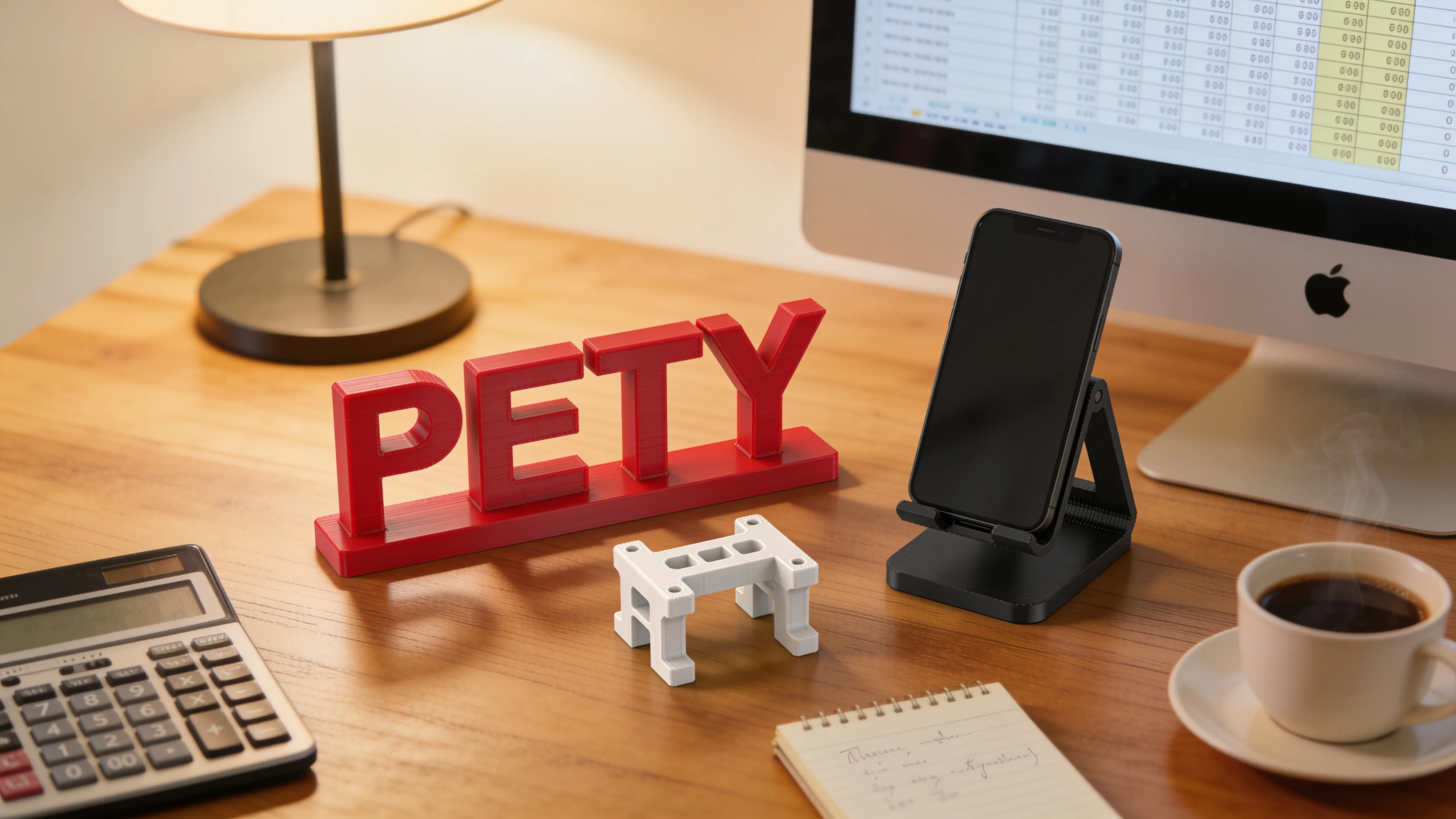
A potential customer sends you an STL file and asks “How much?” This is the moment you either build a profitable side business or accidentally agree to lose $20 over the next six hours. The difference is whether you have a quoting formula or whether you wing it.
This guide gives you the formula. It works for any custom 3D print job — single piece, batch run, or recurring orders. It takes 5 minutes per quote and produces a number you can stand behind when the customer counter-offers. Plus the four mistakes that turn quotes into losses, and the customer-management language that avoids them.
For the full live cost math (with your specific printer’s depreciation, electricity, platform fees, and margin), the Pricing Calculator runs every formula in this article. Use it as your second monitor while you quote.
The 5-minute quoting formula
TRUE_COST = material + electricity + depreciation + labor + failure_buffer
QUOTE = TRUE_COST × (1 + custom_margin)
Where custom_margin for one-off jobs should be 100-200% — much higher than your standard product margin because:
- Customs have more uncertainty (geometry might fail, customer might change spec)
- Customs take more labor (slicing, communication, packaging is custom)
- Customs are non-repeatable — you don’t amortize learning across multiple sales
For a typical custom job:
- Production cost: $5-15 (depending on size and material)
- Custom quote: $20-45 (3-4× cost, including 100-200% margin)
- If platform fees apply (Etsy listing): add another 15-20% on top
The 5 steps in detail
Step 1: Get the print specs (1 minute)
Drop the STL into your slicer. Note:
- Filament weight (grams) — from the slicer’s preview
- Print time (hours) — from the slicer’s preview
- Material requirement — does the customer need PLA or PETG or ABS? Ask if unclear.
If the customer hasn’t sent an STL but just a description, ask. Don’t quote on vague descriptions — they always end up larger and more complex than expected.
Step 2: Calculate true production cost (2 minutes)
Five lines:
| Cost | Formula | Example (50g PLA, 4 hours, P1S) |
|---|---|---|
| Material | weight × $/kg ÷ 1000 | 50 × 19.99 ÷ 1000 = $1.00 |
| Electricity | watts × hours × $/kWh ÷ 1000 | 130 × 4 × 0.16 ÷ 1000 = $0.08 |
| Depreciation | (printer$ ÷ lifetime_hrs) × hours | (700 ÷ 6000) × 4 = $0.47 |
| Labor | minutes × $/hour ÷ 60 | 25 × 20 ÷ 60 = $8.33 |
| Failure buffer | 5-15% × subtotal | (1.00 + 0.08 + 0.47 + 8.33) × 0.08 = $0.79 |
| TRUE COST | sum | $10.67 |
Notice labor is the dominant cost. Custom jobs have higher labor than retail because:
- 5-10 min slicing the file
- 5 min bed prep + print start
- 5-10 min post-processing
- 5 min packaging + custom-quote shipping decision
- 5-10 min customer communication (clarifying requirements, sending updates)
Total: 25-40 minutes per custom job vs 10-15 for a repeat retail item.
Step 3: Apply the custom margin (1 minute)
For a hobby seller doing customs casually: 100% margin = quote at 2× cost = $21 For a serious side business: 150% margin = 2.5× cost = $27 For premium/specialty work: 200% margin = 3× cost = $32
Higher margin if:
- Material is exotic (carbon fiber, multi-color, dental resin)
- Customer needs it fast (next-day = +50%)
- Geometry is risky (overhangs, large supports, tight tolerances)
- Customer wants design help (not just printing) — bill separately at $50-100/hr
Lower margin if:
- Large quantity (10+ units at once) — drops to 75-100% margin
- Repeat customer with simple jobs — drops to 50-75% margin
- The customer is a friend (your business; not advised)
Step 4: Add platform/shipping costs (30 seconds)
If you’re going through Etsy or eBay, you’re paying platform fees on the gross. To net the same after fees, mark up by another 12-20%:
| Platform | Markup needed to maintain net |
|---|---|
| Etsy (no off-site ads triggered) | +12% |
| Etsy (off-site ads, >$10K seller) | +25% |
| eBay (no store) | +17% |
| Amazon Handmade | +18% |
| Shopify w/ Shopify Payments | +4% |
| Direct sale (cash, Venmo, Zelle) | 0% |
Don’t forget shipping. If you’re charging buyer for shipping, that’s fine. If you’re including shipping in the price (“free shipping”), add USPS Priority cost (~$8-15 for small package) to your quote.
Step 5: Round up to a clean number
A $27.42 quote feels chinsy. A $30 quote feels deliberate.
Round up to the nearest $5 (or $10 for higher-value orders). Customers expect round-ish numbers from professional services. Don’t itemize your math in the quote — give them the number and offer to explain if they ask.
A complete example
Customer asks for 5 custom name signs. Each is ~80g PETG, ~6 hours print time. They want them by Friday (it’s Tuesday).
Step 1 — Specs:
  Per sign: 80g, 6h, PETG, 5 quantity, 3-day deadline

Step 2 — Production cost (per sign):
  Material:     80 × 22.99 ÷ 1000 = $1.84
  Electricity:  130 × 6 × 0.16 ÷ 1000 = $0.12
  Depreciation: (700 ÷ 6000) × 6 = $0.70
  Labor:        20 min × 20 ÷ 60 = $6.67 (lower per-unit because batching)
  Failure:      8% buffer = $0.75
  TRUE COST per sign: $10.08
  TOTAL for 5: $50.40

Step 3 — Custom margin:
  100% margin (5+ quantity, no rush premium yet) = $100.80
  Add rush premium (50% for 3-day deadline): $150
  Round: $150

Step 4 — Platform:
  Sold direct via Instagram DM → no platform markup
  Shipping: USPS Priority Medium Flat Rate $18
  Customer pays shipping separately

Final quote: $150 + $18 shipping = $168 ($30/sign + $18 ship)
The customer-facing message: “5 custom signs in PETG: $150 for the set, plus $18 shipping. Ready by Friday.”
If they push back (“$30 per sign feels high”), you can either:
- Negotiate down on quantity discount (drop to $125 for 5 = $25/sign)
- Drop the rush premium (“If we can do Tuesday instead, $125”)
- Hold firm with justification (“$30 covers custom design time + rush turnaround”)
What you don’t do is drop below your TRUE COST × 1.2 (= $60 minimum). Below that, you’re paying the customer to take your time.
The 4 mistakes that kill custom-quote margins
Mistake 1: Quoting only based on filament weight
“It’s only 80 grams of filament at $22.99/kg, so material cost is $1.84. I’ll charge $5 each — that’s 2.7× markup, plenty of margin!” → You just agreed to make $25 for 30 hours of work on 5 signs.
Filament weight is the smallest cost line. Always do the full 5-line calculation, even for “small” jobs.
Mistake 2: Skipping the failure buffer
A 6-hour print at 8% failure rate doesn’t mean “it’ll succeed 92% of the time.” It means across all your custom prints, 8% will need reprints. The failure buffer is your insurance pool — don’t skip it.
If you’re skipping it because “I haven’t had a failed print in months,” consider that you’re due. Or your sample size is too small. The 5-8% baseline is calibrated against thousands of prints across the community.
Mistake 3: Not charging for slicing time / file fixes
Customer sends an STL that’s full of non-manifold geometry or has features that won’t print without support. You spend 30 minutes in Meshmixer fixing it. That’s $10-15 of labor that needs to be in the quote.
Quote separately for design/file-prep: charge $50-100/hr for any STL fixing, redesign, or model creation work. Hours are tracked, billed at end of project. This frame protects you from custom orders that bleed time you can’t recover.
Mistake 4: Not factoring customer communication
Average custom order: 8-15 messages back and forth (initial inquiry, clarification, mockup approval, status updates, shipping confirmation, follow-up). That’s 30-60 minutes of customer service time per order.
Include this in your labor estimate. 25 minutes per order minimum for printing + 15 minutes minimum for communication = 40 minutes total per custom job, even on a simple one.
Recurring customer rates
If a customer asks “Can you make these regularly for me?” the math changes:
- Drop custom margin from 100-200% to 60-100% (less uncertainty per job)
- Set up a fixed pricing schedule (“$20 per sign, billed monthly”)
- Skip communication overhead after the first 3 orders (relationship is set)
- Consider minimum order quantities to amortize bed prep
For a recurring relationship:
- Production cost stays the same
- Custom margin drops to 75% (vs 150% for one-offs)
- Communication labor drops to 5 min/order
- Result: pricing is 30-40% lower than one-off, customer gets a “bulk rate” feel
Quote-rejection handling
Customer says “$30 each is too expensive.”
Three responses, in order of when to use them:
- Educate them — “The $30 covers the 6-hour print time, custom material adjustment, and 3-day turnaround. For a simpler design or longer timeline, I could offer $22.”
- Trim scope — “I could do it in PLA instead of PETG (cheaper material) for $24.”
- Walk away — “I understand. For this kind of work, my minimum is $25 per piece. Happy to refer you to a service that might match your budget.”
Don’t drop to $15. Once you’ve established yourself as the $15 vendor, you can’t move back up. Better to lose the sale than commit to losing money.
Quote acceptance & follow-through
When the customer accepts:
- Confirm scope in writing. Reply with: “Confirming: 5 PETG signs, $30 each + $18 shipping, ready by Friday May 30. 50% deposit ($75) to start, balance on delivery. Sound good?”
- Collect deposit. Venmo, PayPal F&F, Stripe link — your choice. 50% deposit screens out flaky customers and covers material cost.
- Start printing the day you receive the deposit. Not before. (Pre-printing speculatively for “almost-confirmed” customers is how you accumulate inventory of stuff nobody buys.)
- Send a status update at the halfway mark. Photo of progress, ETA confirmation. Customers love it. Costs you 30 seconds.
- Ship + final invoice on completion.
The recurring framework
For every custom inquiry:
- STL or detailed description → into the slicer for weight + time
- Calculator (or this article’s formula) → TRUE COST
- × 2-3 for custom margin + platform markup
- Round to clean number
- Quote, with scope confirmation, deposit terms, deadline
- Wait for deposit, then print
- Update at halfway, deliver on time
5 minutes to quote, ~40 minutes total labor per order, $20-40 net margin per simple job. Scales to $500+/month side income at 10-15 orders/month.
For the live calculator that runs every formula here automatically: Pricing Calculator. Pre-loaded with 60+ printer specs so you don’t have to look up depreciation rates per machine.
For the full pricing strategy across both custom and standard product lines, How to Price Your 3D Prints in 2026 is the pillar piece.